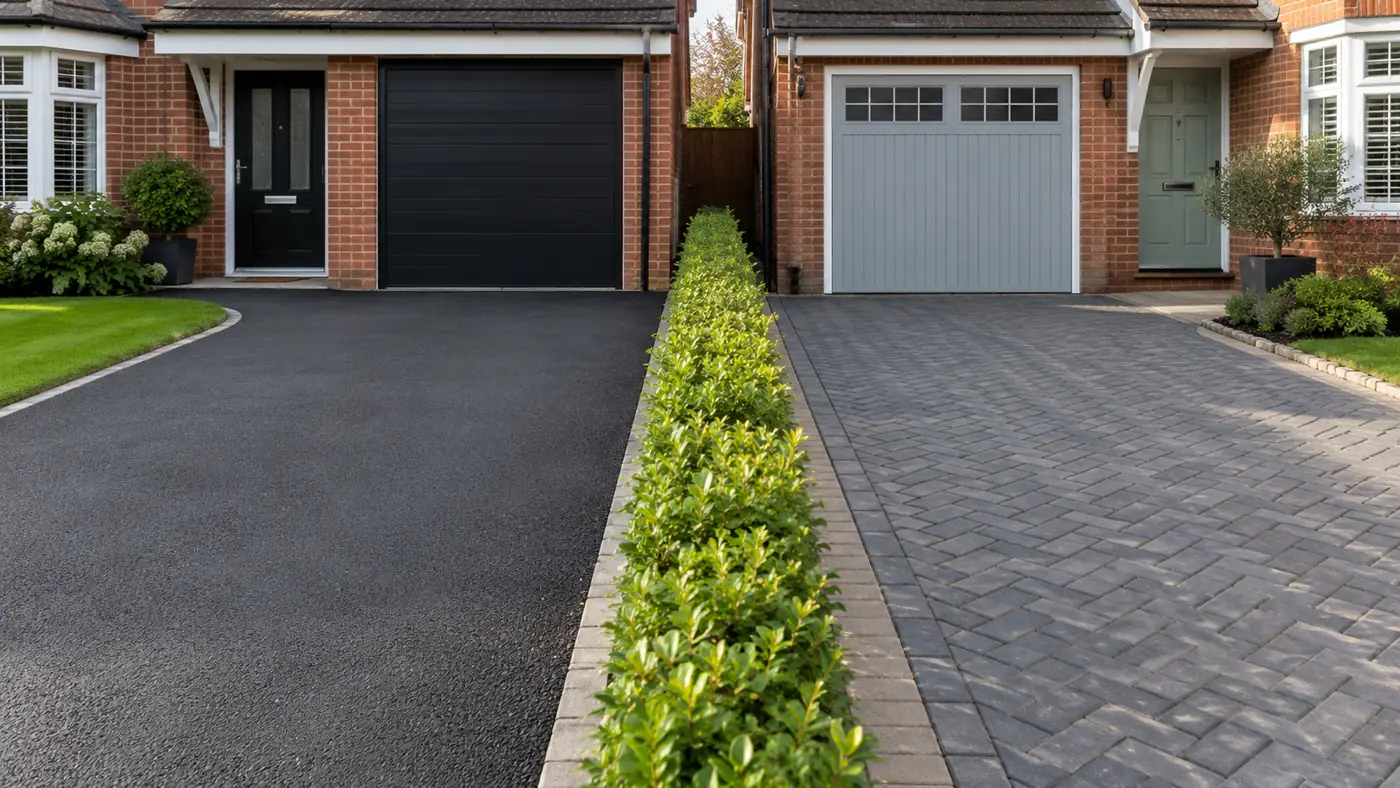
50m² cost comparison
| Tarmac | Block paving | |
|---|---|---|
| National price example | £4,500 | £5,000 |
| Appearance | Continuous, smooth finish | Colours and patterns |
| Local repairs | Patch may remain visible | Some blocks can be replaced |
| Joint upkeep | Few surface joints | Sand and weed attention |
The £500 difference is an illustrative national comparison, not a promise for a particular address. A proper quote could reverse the order.
When tarmac makes sense
You want a practical, relatively smooth finish, straightforward vehicle access and no intricate colour pattern. Ask about edge restraints, base quality and drainage.
When block paving makes sense
You value patterned paving and potentially replaceable units, and can maintain jointing sand and manage weeds. Complex curves and decorative borders may increase labour.
Drainage is not an optional detail
Neither ordinary dense tarmac nor standard impermeable blocks should be assumed to drain through. Both can be specified with appropriate drainage; genuinely permeable block paving uses a designed system of units, joints and base layers.
How to get a fair comparison
Choose one measured area, specify whether the existing drive will be removed, and ask both contractors to include waste, base, drainage, kerbs and VAT. Then compare your tarmac and block-paving budgets using equivalent selections.
Common questions
Does tarmac need less maintenance?
It avoids block-paving joints but can develop cracks, stains and wear. The maintenance burden depends on drainage, construction and use.
Is block paving better for a patterned driveway?
Yes, individual blocks allow varied colours, borders and patterns. The extra detail should be included in the written specification.
Sources and important notes
Published 2 November 2026. The figures are broad UK examples for ordinary installations; they are not fixed contractor prices and do not account for every site condition.