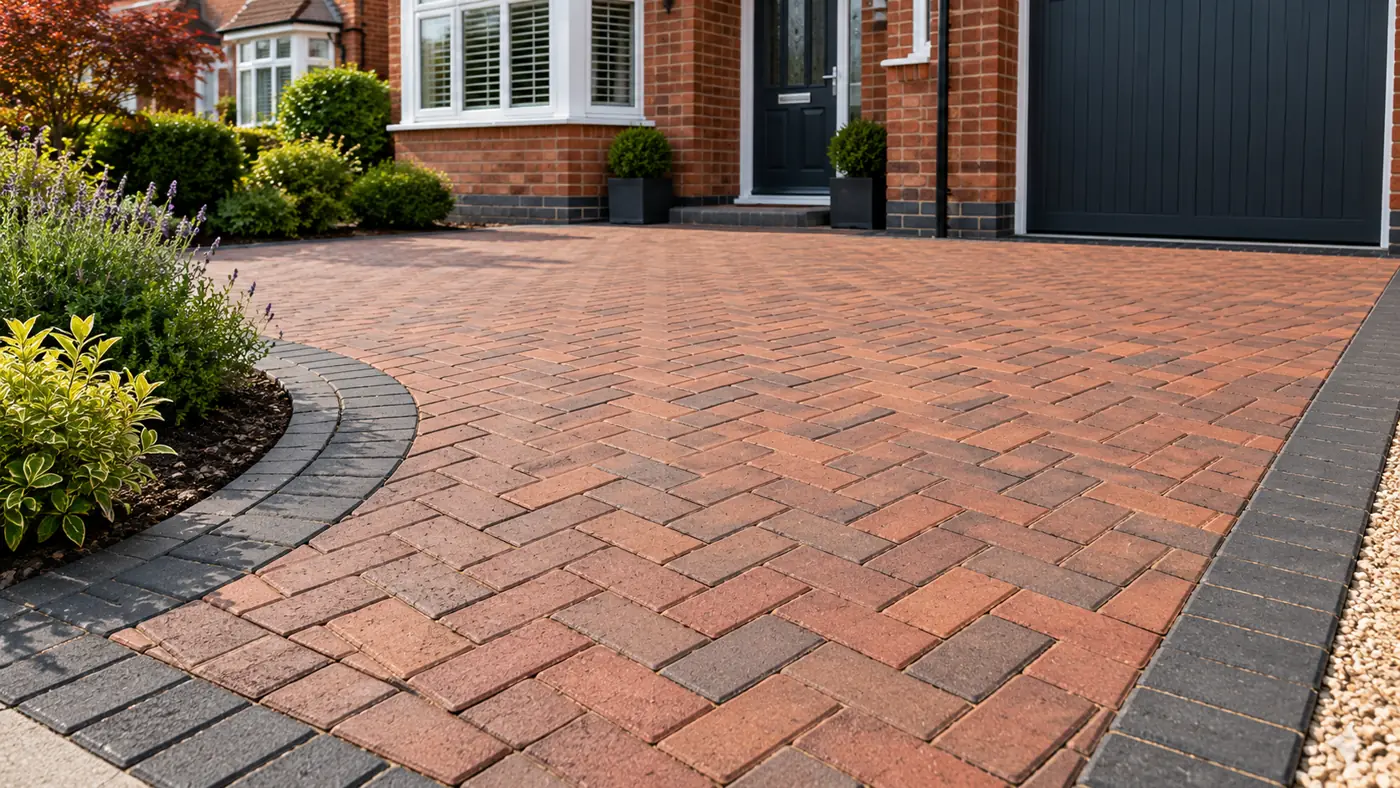
Three patterns to discuss with your installer
| Pattern | Appearance | What to check |
|---|---|---|
| 45° or 90° herringbone | Interlocking zigzag | Border cuts, block type and restraints |
| Stretcher bond | Offset straight rows | Suitability for vehicle loading and turning |
| Basket weave | Grouped alternating blocks | Block proportions and vehicle-use specification |
For trafficked driveways, an installer may recommend interlocking patterns such as herringbone. Do not assume every decorative layout is appropriate for the wheel loads and turning forces on your plot.
Where extra labour appears
Angles, curved edges, small cut pieces, contrasting borders and changes in levels all add cutting and finishing. Ask whether the quote includes edge restraints and jointing sand.
How to avoid a busy look
Many UK homes benefit from one primary block colour and a restrained border. A strong pattern in the paving can do enough without additional stripes.
Patterns cannot fix a weak driveway base
Correct excavation, sub-base compaction and drainage are fundamental. A perfect herringbone layout can still settle if the ground preparation is unsuitable.
Work the design into the quote
Our block-paving budget guide covers standard installed-price examples. The calculator gives an indicative surface budget; an installer must price your chosen pattern, cuts and border details.
Common questions
Is herringbone best for a driveway?
It is widely used on trafficked paving, but the chosen product and construction must suit the vehicle load and site.
Do elaborate patterns cost more?
Complex borders and extra cutting can increase labour, although the exact difference depends on block type and site geometry.
Sources and important notes
Published 2 November 2026. The figures are broad UK examples for ordinary installations; they are not fixed contractor prices and do not account for every site condition.